Money readers are the highest‑paying readers on the internet.
Writing for them used to take a credential. Now it takes a method.
The first half has been true for decades: a reader deciding where to put money is worth ten to fifty times a reader deciding anything else, and investors pay directly for research worth reading. The second half is new. Analyst-grade coverage used to take a team, a terminal, and a credential. It now takes a method, a desk that reads the SEC filings for you, and the discipline to verify what it hands you before you sign it.
That paragraph is the whole pitch. Everything below it is the evidence: the niche economics with sources, the desk's output next to a blank chatbot's, a 43-second film of a real working session, and the honest numbers most pitches hide. Read it the way an analyst would. That is the job you'd be taking.
The niche sets the ceiling.
Money readers pay most, and not because finance content is harder to write. A reader deciding where to put money is worth multiples of a reader deciding where to go on vacation. Advertisers price it, platforms price it, and investors pay directly for research worth reading. That's why serious equity coverage is the one kind of writing where a small readership is a real business.
10–50x
more per reader that advertisers pay to reach a finance audience versus a general one
$2,700/yr
a 1,000-subscriber finance newsletter, versus $252/yr for a same-size travel list
1. YouTube CPM by niche: vidIQ reports finance, insurance, and legal niches paying $15-50 CPM while gaming and entertainment sit at $1-8; per OutlierKit, a personal-finance channel earns $30+ CPM vs. ~$3 for gaming.
2. Newsletter economics: by Beehiiv's benchmarks, a 1,000-subscriber investing newsletter can earn more than $2,700/year; the median 1,000-subscriber travel newsletter earns about $252/year.
“But I don't know finance.”
Neither did the two English majors who started The Motley Fool as a newsletter to their parents' friends. Neither did the file clerk who launched a financial publishing empire from his kitchen table on a borrowed laptop.
What they had was a method: read the filings, follow the numbers, write it so a non-specialist could use it. That method is what the MoneyPress desk runs.
They did it with typewriters and mailing lists.
You have AI.
What the desk actually does
You pick a coverage lane (regional banks, specialty insurers, small-cap mining, whatever corner of the market you'd actually read about). Then the loop runs in your browser, one working session per article:
- 01Name a ticker. The desk builds a research brief the way an analyst would: the business classified, candidate angles argued for and against, every material figure tied to a named source document, nothing invented. It reads the SEC's EDGAR system live, so the brief arrives already carrying the company's actual filed numbers, its latest press release, and a fresh web sweep of what analysts and competitors are saying. Any US-listed company works, foreign filers included.
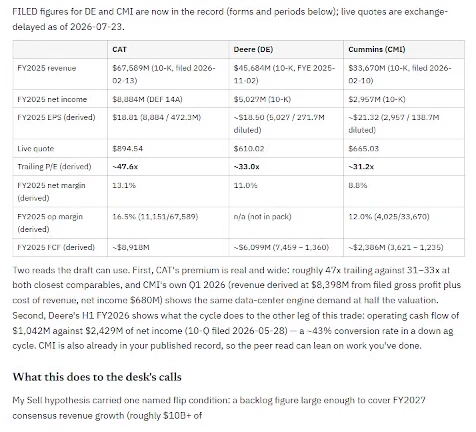
- 02Verify what you can. The filings are free and the brief links them. Correct what's wrong, confirm what's right, or accept the desk's own confidence-labeled defaults and keep moving. Name a competitor and the desk pulls its filed numbers too, so your valuation multiples stand on something.
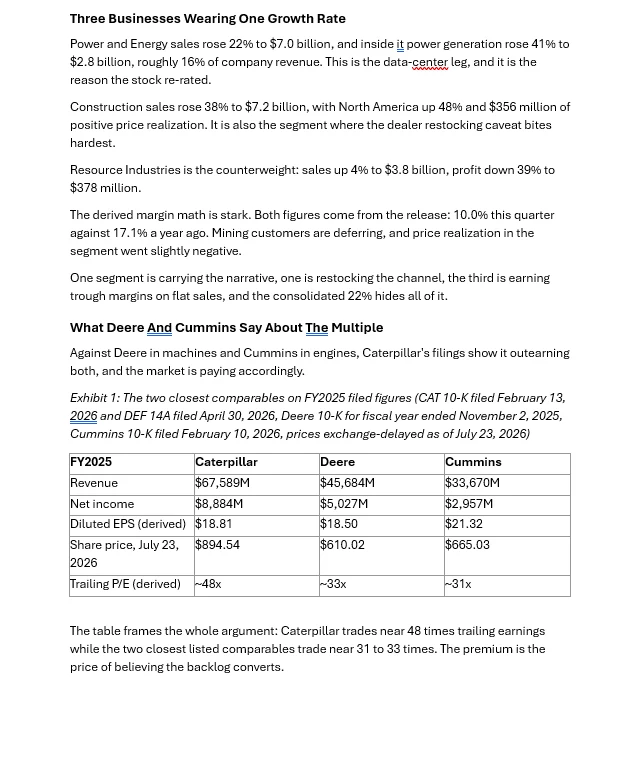
- 03Ask for the draft. It writes from your session's record alone, structured the way a research note is structured. Only sourced figures enter the body; anything unverified waits in a checklist under the draft instead of hiding inside it. Exhibit tables are built from the filed numbers, and the whole piece downloads as a Word file with its sources linked.
- 04The blind panel reads it cold. A second, fresh pass with no memory of your session judges whether the piece reads human-written, re-runs its arithmetic, and lists exactly what to fix before an editor ever sees it.
- 05You edit, decide, publish. In your own words, under your own name, on your own account.
A fresh session unlocks every day, and each one carries the working room for a complete article. The method wants one or two published pieces a week; a desk that turns up daily is what makes that cadence easy to keep. Depth is the entire point: one sourced, checkable piece a week beats thirty pages of slop nobody trusts.
One working session, compressed to 43 seconds
A blank chat's draft
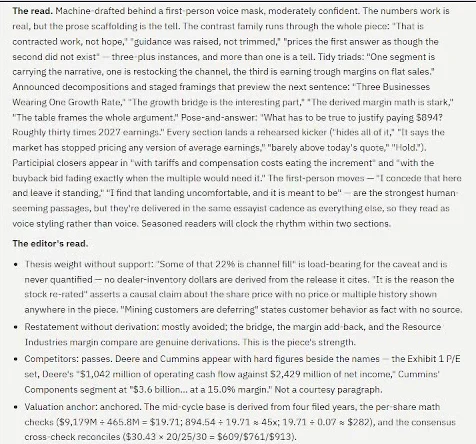
“Global Ship Lease isn't just another shipping stock — it's a compelling opportunity hiding in plain sight. With a robust backlog, a resilient business model, and an attractive dividend, the company is well-positioned to navigate today's ever-evolving market landscape. While risks remain, the long-term outlook appears bright. For investors seeking income, growth, and stability, GSL may be worth a closer look — a name to watch in the months ahead.”
No source, no number that can be checked, and every tell an editor deletes on sight: the em dashes, the triads, the hedged kicker.
1. Educational commentary, not investment advice
The desk that checks its own work
Your name on a compounding record
Everything the desk produces is published by you, under your byline, on your own author account, where investors already pay to read equity research. No ad-CPM arbitrage, no SEO roulette, no waiting for an algorithm to bless you. The asset you're building is the record itself: a published archive anyone can check, a following that accrues to your name, an analyst identity that gets more valuable with every sourced piece. A traffic chart resets to zero the day an algorithm changes its mind. A record doesn't.
Illustrative shape, not a data claim.
The desk keeps that record with you. Every draft you finish lands in your coverage history, and when you return to a name you've covered, the next brief opens from what changed since your published call. If the facts have turned, the reversal happens in the open. Your record never contradicts itself by accident, which is exactly the discipline readers pay analysts for.
The numbers, and where each one came from
What's inside
- 01
The Analyst Desk
Your working surface, in the browser: name a ticker and it builds a sourced research brief with a verification checklist; hand back your verified notes and it writes the article draft. A fresh working session every day, thirty or so a month. Each session carries the working room for a complete article: research, verification, draft, blind read, revisions. Nothing to install, no AI subscription needed.
- 02
The Manual
One operating manual, two parts. Part I runs the desk: the working loop from research brief to verified draft to the blind panel read. Part II is the money method: where analyst-grade research gets published and paid for, account setup, editorial review, and the realistic path from your first piece to your first hundred followers. Honest math, no income promised.
No face on camera. No inventory. No five-figure “mastermind.”
And you don't have to take the letter's word for any of it. Run the loop on a company you already know, read what comes back, and judge the output rather than the pitch. If it doesn't hold up, the guarantee gives you your money back inside thirty days.
$100
One hundred dollars a month. That is the whole price: no tiers, no upsells. A fresh working session every day, the full Manual, cancel whenever you like.
A fresh session every day · cancel anytime · 30-day guarantee
30-day money-back guarantee
If MoneyPress isn't right for you, email for a refund of your first payment, the full $100, any time within 30 days. One condition, stated here rather than buried: the guarantee holds while you've started five desk sessions or fewer. Five sessions is working room for two complete articles, which is enough to know. Past that, the desk has done real work at real cost, and the month is simply yours. The membership cancels in one click, any month, no exit interview. This is a refund guarantee: it says nothing about what you will earn, only that finding out whether the desk is for you won't cost you anything.
Honest numbers up front: the median side hustle pays $200/month.
$75
My average earnings per published article. Each article starts as roughly one 30-minute working session at the desk.
That's my average across my own published articles. It's mine, not a promise of yours. Results are not typical: most side hustles earn around $200/month, and this model takes months to build, not days.
1. Bankrate side-hustle survey, July 2025: median side-hustle income is $200/month (average $885).
What you actually walk away with
Who this is NOT for
- People who want money this week.
- People who won't write consistently, week after week.
- People looking for a guaranteed return.
They did it with typewriters and mailing lists. You have AI.
$100
One hundred dollars a month. That is the whole price: no tiers, no upsells. A fresh working session every day, the full Manual, cancel whenever you like.
30-day money-back guarantee
A fresh session every day · cancel anytime · 30-day guarantee